 ← THE SCIENCE
The Protocols,
in depth.
A protocol is just a schedule — when you dose and when you rest. The rest is what makes it work. Here is how the common schedules differ, how to find your dose, and how to run a cycle without drifting into habit.
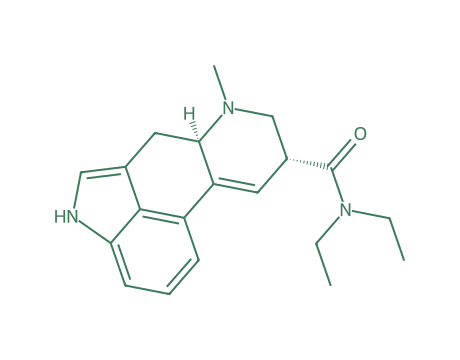
the heavy lifting.
It's tempting to think more frequent is better. It isn't. Tolerance to 5-HT2A agonists builds quickly, so dosing every day blunts the effect within a week and tells you nothing about whether it's helping. Rest days exist for two reasons: they let receptors re-sensitise, and they give you a clean, undosed baseline to compare against.
RE-SENSITISE
A day or two without a dose lets 5-HT2A receptors recover, so the next dose lands the way the first one did rather than fading into nothing.
SEE THE SIGNAL
If every day is a dosing day you can't tell the molecule from your mood. Off-days are the control condition in your own small experiment.
STAY DELIBERATE
A schedule keeps microdosing a practice rather than a reflex. The structure is part of the point — and makes it easy to stop and check in.
Three schedules cover almost everyone. They differ mainly in how often you dose. Start conservative — you can always move to a more frequent rhythm once you know how you respond.
Proposed by Dr. James Fadiman and the most widely used schedule. Day 1 you dose; Day 2 is a "transition" day where after-effects often linger; Day 3 is a full rest; then repeat. The two off-days make it the gentlest on tolerance and the easiest to read.
Adapted from Paul Stamets' psilocybin "stack." Four consecutive dosing days, then three off. More frequent than Fadiman, often paired with Lion's Mane and a small dose of niacin. Favoured by those chasing sustained plasticity rather than an acute lift — but it leans harder on tolerance, so the rest block matters.
A simple fixed rhythm favoured by the Microdosing Institute: dose once every third day, no transition-day concept to track. Predictable and easy to keep to. In practice it lands very close to Fadiman, with a touch more structure.
Move slowly.
The single most common mistake is starting too high. A microdose should be sub-perceptual: a quiet lift, not a noticeable shift. If you can clearly tell you took something, that's not a microdose — it's a low dose, and a different experience.
Begin below the line
Start at the very bottom of the range — often a single drop. You're looking for "nothing obvious, but a slightly better day," not an effect you can point to.
Hold, don't chase
Keep the same dose for several sessions before judging it. Effects are subtle and cumulative; one day tells you very little.
Adjust in tiny steps
If after several sessions you feel nothing at all, increase by a single drop — not a leap. The window between "nothing" and "too much" is narrow, especially for 2C-B.
day looks like.
The dose is a backdrop; the routine around it does most of the work. Three habits make the difference between guessing and learning.
TIME IT RIGHT
Dose in the morning — these compounds are mildly activating and late dosing can disrupt sleep. Take it sublingually (held 60–90 seconds) or in room-temperature water. A light meal is fine; never use hot liquids.
KEEP A JOURNAL
One line a day is enough: dose, mood, focus, sleep, anything notable. Over weeks the pattern — not any single day — is what tells you whether it's working. It's also the only way to separate signal from expectation.
INTEGRATE IT
Pair dosing days with the work you actually want to improve — a hard problem, a creative session, a long walk. Set an intention. The molecule doesn't supply direction; you do.
LOG THIS DAILY
Dose (drops/amount) · mood (1–5) · focus (1–5) · sleep last night · side effects · one sentence on the day.
DON'T STACK VARIABLES
Avoid starting other supplements, new medications, or heavy caffeine on the same day you change your dose — you won't know what did what.
rest it.
A protocol isn't forever. Run a cycle of four to eight weeks, then take a full break of two to four weeks before deciding whether to start another. Breaks aren't a failure of discipline — they're how you find out whether the benefit holds on its own.
WHY CYCLE
Even on a good schedule, sensitivity drifts and routines calcify. A break resets tolerance, re-establishes a clean baseline, and surfaces whether gains you've noticed persist without dosing — the most useful thing you can learn.
WHAT A BREAK LOOKS LIKE
Simply stop dosing for two to four weeks. Keep journaling. If mood and focus hold, you may not need to resume at all; if they fade, you've learned the practice was doing something — and can restart deliberately.
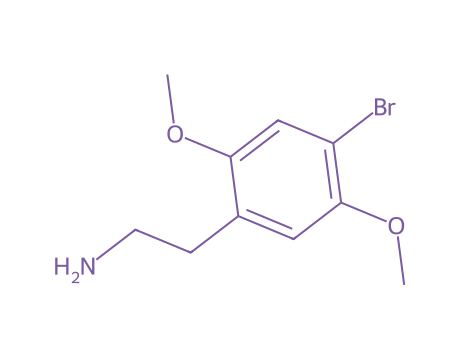
then a reset.
A full Fadiman cycle: six weeks of 1-on / 2-off dosing, followed by a two-week break. This is an illustration, not a prescription—adjust to your response and begin cautiously.
Pause dosing for 14 consecutive days. Keep journaling so you can see what holds without the protocol.