Questions,
answered.
Everything about the products, the molecules, the protocols and using them responsibly — gathered in one place and written plainly. For deeper reading, see the Science section.
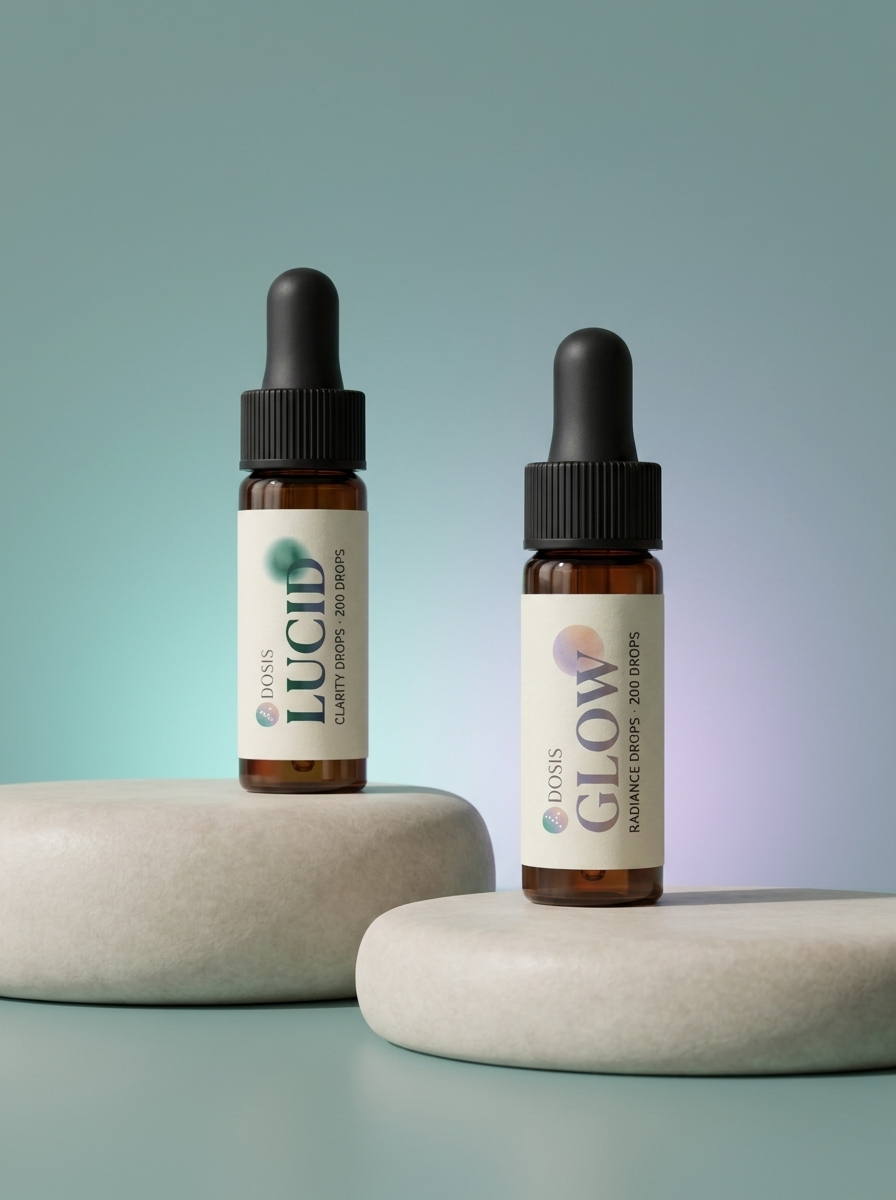
LUCID (LSD-25) is head-centered — cognitive sharpening, sustained focus and analytical clarity, favoured for deep work. GLOW (2C-B HCl) is heart- and body-centered — sensory warmth, emotional openness and creative flow. Many people alternate between the two across the week rather than choosing one. See the full molecule comparison in the Science section.
LUCID is positioned around cognitive clarity and a longer LSD-25 arc. GLOW is positioned around sensory warmth, connection, and the shorter 2C-B window.
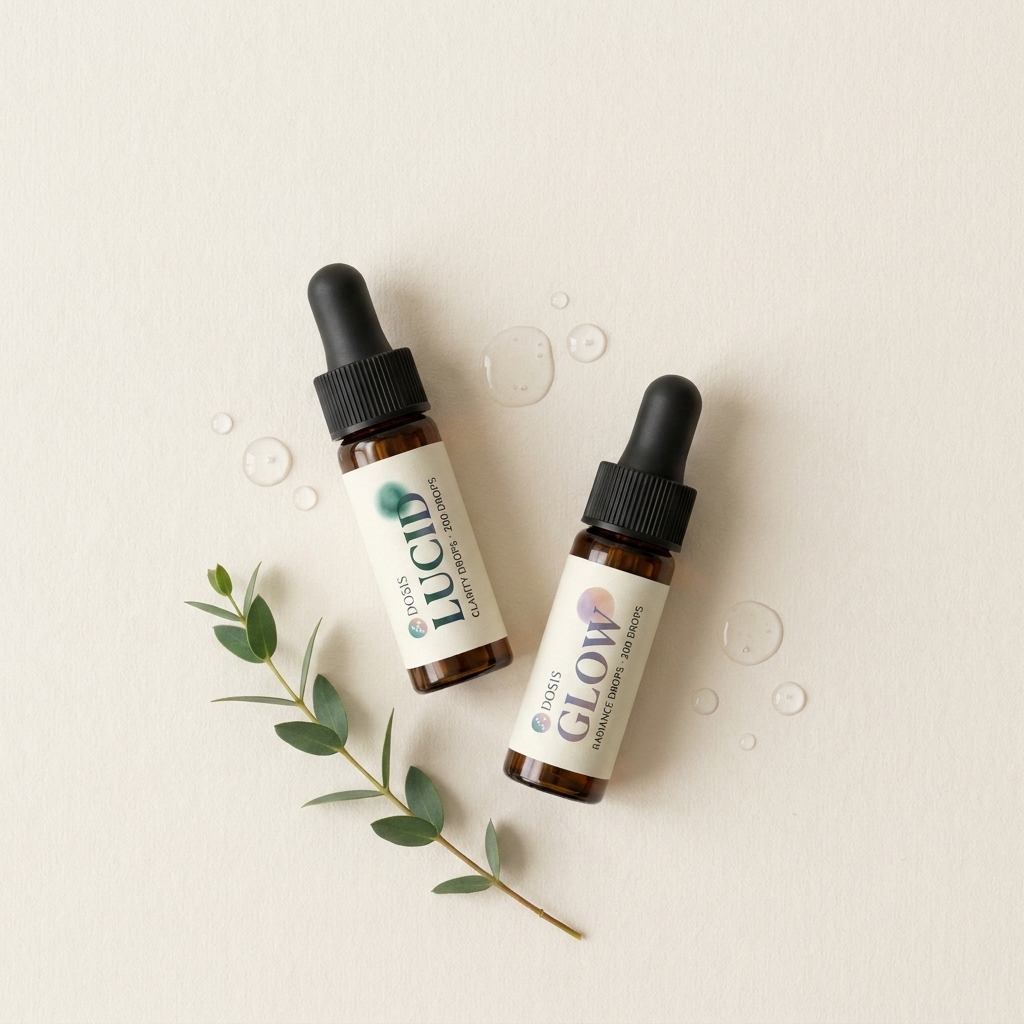
Each vial holds roughly 200 calibrated drops. At microdose levels (1–4 drops) that's about 50–200 individual sessions per vial, depending on your dose.
A USP-grade ethanol carrier. Ethanol preserves the compound, prevents microbial growth and aids sublingual absorption. The active compound is dissolved at a known concentration so each drop delivers a consistent dose.
Lysergic acid diethylamide — a lysergamide first synthesized by Albert Hofmann at Sandoz in 1938 (C₂₀H₂₅N₃O, 323.43 g/mol). It's one of the most potent known 5-HT2A receptor agonists. Full structure, pharmacology and primary literature are on the LUCID molecule profile.
4-bromo-2,5-dimethoxyphenethylamine — a phenethylamine of the "2C" family first made by Alexander Shulgin in 1974 (C₁₀H₁₄BrNO₂, 260.13 g/mol). It acts at 5-HT2A and 5-HT2C receptors and is markedly less studied than LSD. Details on the GLOW molecule profile.
Both act primarily as agonists at the serotonin 5-HT2A receptor on cortical neurons, increasing glutamatergic signalling in the prefrontal cortex. Downstream, this is thought to drive a brief rise in neuroplasticity (BDNF → TrkB → mTOR) — which is why classic psychedelics are called "psychoplastogens." At microdose levels these effects are far subtler than at full doses.
It's promising but unsettled. Survey and open-label data are broadly positive for mood, focus and creativity, but the best placebo-controlled work — notably the large self-blinding study by Szigeti et al. (2021) — found much of the reported benefit is explained by expectation. That doesn't make the benefit fake, but it means microdosing should be treated as preliminary and under-studied, not proven. The Science section links the primary sources, including the sceptical ones.
It means a dose low enough that you should not feel "high" or notice obvious perceptual changes. The intent is a quiet lift in mood, focus or flexibility — enhanced, not altered. A useful rule: if you can clearly tell you took something, you took too much.
Three common schedules: the Fadiman protocol (Day 1 dose, Day 2 transition, Day 3 rest, repeat); the Stamets-style four-days-on, three-off; and a simple every-third-day cadence. Whichever you choose, run 4–8 weeks then take a 2–4 week break. Off-days matter — they let receptors re-sensitise and give you a clean baseline. Full detail in the Science protocols guide.
Start lower than you think — often a single drop — and titrate slowly over several sessions. The goal is the sub-perceptual range. Each product page carries a full dosing table calibrated to that molecule: LUCID dosing and GLOW dosing.
Dose in the morning — these compounds are mildly activating and late dosing can disrupt sleep. Sublingual (held under the tongue 60–90 seconds) gives the fastest, most reliable onset; drops can also be taken in room-temperature water or juice. Never use hot liquids, which degrade the compound. A light meal is fine; a heavy one can slow onset.
For analytical focus and deep work, people tend toward LUCID's head-centered character. For creativity, mood and sensory openness, GLOW's heart-centered warmth. There's no rule — rotating between them is common. The lifestyle & productivity section walks through use-cases honestly.
Stacking pairs a microdose with supportive supplements thought to extend neuroplasticity or smooth the experience — the best-known being the Stamets stack (microdose + Lion's Mane + a little niacin). Evidence is early; treat these as wellness support, not a cure. See the stacking guide on each product page.
Yes. Tolerance to 5-HT2A agonists builds quickly, so every protocol includes rest days, and after 4–8 weeks you should take 2–4 weeks fully off. Breaks also confirm whether any benefit is holding on its own rather than becoming a habit.
At genuinely sub-perceptual doses the physiological risk is generally low, but "low" is not "none" — a few drug interactions are dangerous and some people should not microdose at all (see below). This is harm-reduction information, not medical advice. Start at the lowest dose, keep a journal, and involve a clinician if you take any daily medication.
Lithium — avoid entirely; combined with classic psychedelics it's linked to seizures and serious adverse events. SSRIs/SNRIs often blunt or abolish effects (never stop prescribed antidepressants on your own to "feel" a dose). MAOIs can unpredictably alter intensity. Seizure-threshold-lowering drugs (tramadol, bupropion, stimulants) should be combined cautiously, if at all.
Anyone with a personal or family history of psychosis, schizophrenia or bipolar disorder (psychedelics can precipitate episodes); anyone pregnant or breastfeeding; anyone under 18; and anyone on the interacting medications above. If you're drawn to it out of distress rather than curiosity, that's also a reason to wait and talk to someone.
A correct microdose should not impair you — but everyone's response differs, and the first few sessions are about learning yours. Don't drive or operate machinery if you feel any effect at all, and don't dose for the first time before something that demands full attention.
While you're learning your response, no. Avoid alcohol and other substances on dosing days so you can read effects cleanly and avoid unknown interactions. Add nothing else into the picture until you understand your baseline.
In its amber glass vial, in a cool, dark place away from heat and direct light. The amber glass and ethanol carrier both help protect the compound. Keep it out of reach of children and anyone who shouldn't have access.
A gentle shake before dosing helps keep the solution even. Then hold the dropper vertically and count drops at a steady pace for the most consistent measure.
Light and heat degrade these compounds; amber glass blocks much of the light and a cool, dark store handles the rest. The ethanol carrier preserves the solution, discourages microbial growth and improves sublingual absorption — which is also why hot liquids should never be used for dosing.
LSD and 2C-B are controlled substances in most jurisdictions. Their legal status varies by country and region and can change. Know and follow the laws where you live — nothing on this site is encouragement to break them.
No. Everything here is for educational and harm-reduction purposes only and has not been evaluated by any regulatory body. It is not a substitute for a conversation with a qualified healthcare provider — especially if you take daily medication or manage a health condition.
The field is advancing quickly — psilocybin- and MDMA-assisted therapy have reached late-stage trials and are under active regulatory review. But that research studies full, supervised therapeutic doses, which is different from self-directed microdosing. Optimism is reasonable; certainty isn't yet warranted. We try to reflect that honestly throughout the site.
The Science section is the deep end: protocols and how-to, lifestyle and productivity use-cases, the molecule index with primary research, and a full safety and responsible-use section.
Still have a question?
Start with the Science section for the molecules and protocols, or look over the products themselves.