
The molecule,
the method, the mind.
A working guide to microdosing — what these compounds are, how people fold them into focused work and a fuller life, and how to do it responsibly. Written to inform, not to oversell: the science here is real, promising, and still emerging.
studied carefully.
Microdosing means taking a sub-perceptual amount of a psychedelic — roughly a tenth of a recreational dose — on a schedule, with the aim of a subtle lift in mood, focus and creativity rather than an altered state. The idea isn't new, but the rigorous study of it is. This guide collects what's reasonably well understood, what's promising, and what's still unproven, so you can decide for yourself.
Protocols & How-To
Dosing schedules (Fadiman, Stamets, every-third-day), titration, timing, journaling, integration, and how to cycle to avoid tolerance.
READ THE PROTOCOLS → 02 · APPLICATIONLifestyle & Productivity
How people apply microdosing to deep work, creativity, mood, movement and connection — and what the current evidence actually supports.
EXPLORE USE-CASES → 03 · SCIENCEThe Molecule Index
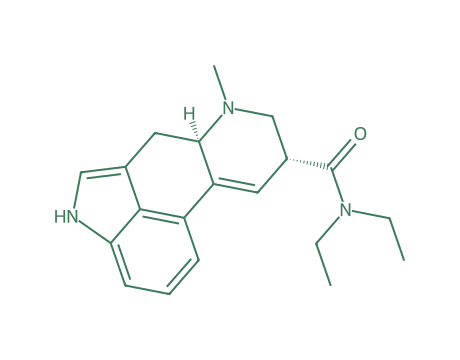
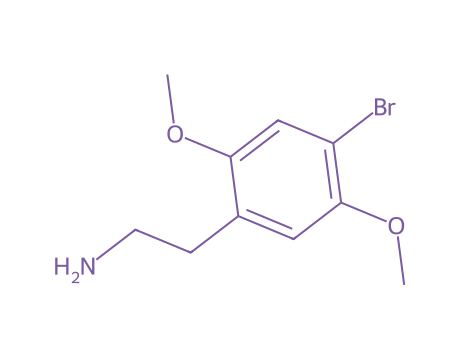
LSD-25 and 2C-B side by side: structure, pharmacology, receptor targets, character and the primary research behind each.
OPEN → 04 · CARESafety & Responsible Use
Contraindications, drug interactions, set and setting, legal status, and the situations where the honest answer is: don't.
READ BEFORE YOU START →01 · DOSE
A sub-perceptual amount, held under the tongue for 60–90 seconds. Enhanced, not altered — if you can clearly feel it, you've taken too much.
02 · PROTOCOL
Dose on a fixed schedule with rest days between, and keep a one-line journal of mood, focus and sleep so real signal separates from expectation.
03 · GROW
Off-days let 5-HT2A receptors re-sensitise. The aim is a gradual, compounding lift over weeks — not any single dramatic day.
to the microdose.
A protocol is just a schedule — when you dose and when you rest. Off-days matter as much as on-days: they let serotonin 5-HT2A receptors re-sensitise and give you a clean baseline to read effects against. Start at the lowest dose, change one variable at a time, and keep notes.
FADIMAN
Day 1 dose · Day 2 transition · Day 3 rest, then repeat. Proposed by Dr. James Fadiman and the most widely used schedule. The rhythm of one on, two off is designed to prevent tolerance and let you observe after-effects on the following day.
STAMETS-STYLE
Four days on, three days off — adapted from Paul Stamets' psilocybin "stack." Often paired with Lion's Mane and a small dose of niacin. More frequent dosing; popular with those chasing sustained plasticity rather than acute effect.
EVERY-THIRD-DAY
A simple fixed cadence favoured by the Microdosing Institute: dose once every third day. Whichever you choose, run a cycle of 4–8 weeks, then take 2–4 weeks off to reset tolerance and check whether the benefit holds without it.
WHICH MOLECULE, WHICH GOAL
The two compounds have different characters. LSD-25 (LUCID) tends head-centered — analytical clarity and sustained focus for deep work. 2C-B (GLOW) tends heart-centered — warmth, sensory richness and creative openness. Many rotate between them rather than choosing one.
READ THE PER-PRODUCT GUIDES
Each product page carries its own full dosing table, delivery methods and stacking guide calibrated to that molecule. Start with LUCID dosing or GLOW dosing for the specifics.
a working life.
Most people who microdose aren't chasing an experience — they're after a slightly better version of an ordinary day. Below are the use-cases people report most, each paired with an honest read of where the evidence stands. Survey and open-label data are encouraging; well-controlled trials are fewer and more sceptical.
DEEP WORK & FOCUS
The most common reason people reach for LSD-25 microdoses: longer, calmer attention on hard problems. Anecdotally strong; in controlled settings the focus benefit is real for some and indistinguishable from placebo for others. Best treated as a possible aid to a good work routine, not a substitute for one.
CREATIVITY & IDEATION
Reports describe looser associations and a willingness to follow unusual ideas. Lab measures of divergent thinking show mixed, modest effects. The practice pairs well with open-ended creative work where there's no single right answer.
MOOD & OUTLOOK
Lifted mood and reduced rumination are among the most consistently reported effects — and also the most placebo-sensitive. Promising as a complement to therapy and lifestyle, not a treatment. If you're managing a mood disorder, involve a clinician.
FLOW & MOVEMENT
Some pair low doses with exercise, yoga or time outdoors, describing easier entry into flow and heightened sensory presence — territory more associated with 2C-B's warmth. Evidence here is almost entirely anecdotal; approach as personal experiment.
CONNECTION & PRESENCE
2C-B's heart-centered character leads some to use it for empathy, conversation and shared experiences. Set and setting dominate outcomes far more than dose. Sociability is not a guaranteed effect and shouldn't be assumed in advance.
THE HONEST CAVEAT
The largest self-blinding study to date (Szigeti et al., 2021) found that much of the reported benefit was explained by expectation. That doesn't make the benefit fake — but it means the practice, the intention and the routine may matter as much as the molecule.
"THE FUTURE OF MEDICATION"?
Psychedelic medicine is moving fast: MDMA- and psilocybin-assisted therapy have reached late-stage trials, and regulators are actively reviewing them. But that work studies full therapeutic doses under supervision — not self-directed microdosing. The microdosing evidence base is younger and more contested. Optimism is warranted; certainty is not.
WHAT WOULD MAKE IT WORK FOR YOU
Realistic expectations, a consistent protocol, a clean baseline (limit other variables on dosing days), honest journaling, and a willingness to stop if it isn't helping. The people who get the most out of it treat it as a deliberate practice — not a daily fix.
two characters.
Both are serotonergic psychedelics acting primarily at the 5-HT2A receptor — but they belong to different chemical families and feel different in practice. Here they are side by side. Each links to a full molecular profile with skeletal structure and primary literature.
Each compound now has its own full science page — pharmacology, dosing, protocols, research and safety, specific to that molecule.
The shared mechanism
Both bind serotonin 5-HT2A receptors on cortical neurons. Activation increases glutamatergic signalling in the prefrontal cortex — the opening move of the brain's plasticity response.
Psychoplastogens
Classic psychedelics promote dendritic growth and synapse formation via BDNF → TrkB → mTOR signalling (Ly & Olson, 2018). They transiently raise the brain's capacity to rewire — the leading hypothesis for why even small doses might matter.
Why LSD lingers
Cryo-EM imaging shows LSD sits unusually deep in the 5-HT2A receptor, under an extracellular "lid" that slows its release — a structural explanation for its long, characteristic action (Wacker et al., 2017).
Why 2C-B is under-studied
2C-B has far less formal pharmacology behind it than LSD. Most of what's documented traces to Alexander Shulgin's own work; rigorous human microdosing data is sparse. Treat its profile as informed but provisional.
SUB-PERCEPTUAL BY DESIGN
At microdose levels the intent is no perceptual change at all — a quiet lift, not an altered state. The same receptors are engaged as at full doses, but far more gently. "Enhanced, not altered" is the whole premise.
GO TO THE SOURCES
Each product page carries a curated, link-out reading list of peer-reviewed work — including the studies that complicate the optimistic story. See LUCID research and GLOW research.

Sub-perceptual doses are generally low-risk physiologically, but a handful of interactions are genuinely dangerous and some people should not microdose at all. This is harm-reduction information, not medical advice — and it does not change the legal status of these compounds where you live.
BEFORE YOU CONSIDER ANYTHING
WHEN THE ANSWER IS "DON'T"
If you're on any of the medications above, managing a serious mental-health condition, pregnant, under 18, or feeling pushed toward it by distress rather than curiosity — microdosing is not for you right now. There is no benefit worth those risks.
IF YOU DO PROCEED
Source carefully, verify what you have, start at the lowest possible dose, never combine with alcohol or other drugs while learning your response, tell someone you trust, and keep a clinician in the loop if you take anything daily.
to the protocol.