The long arc.The shorter window.
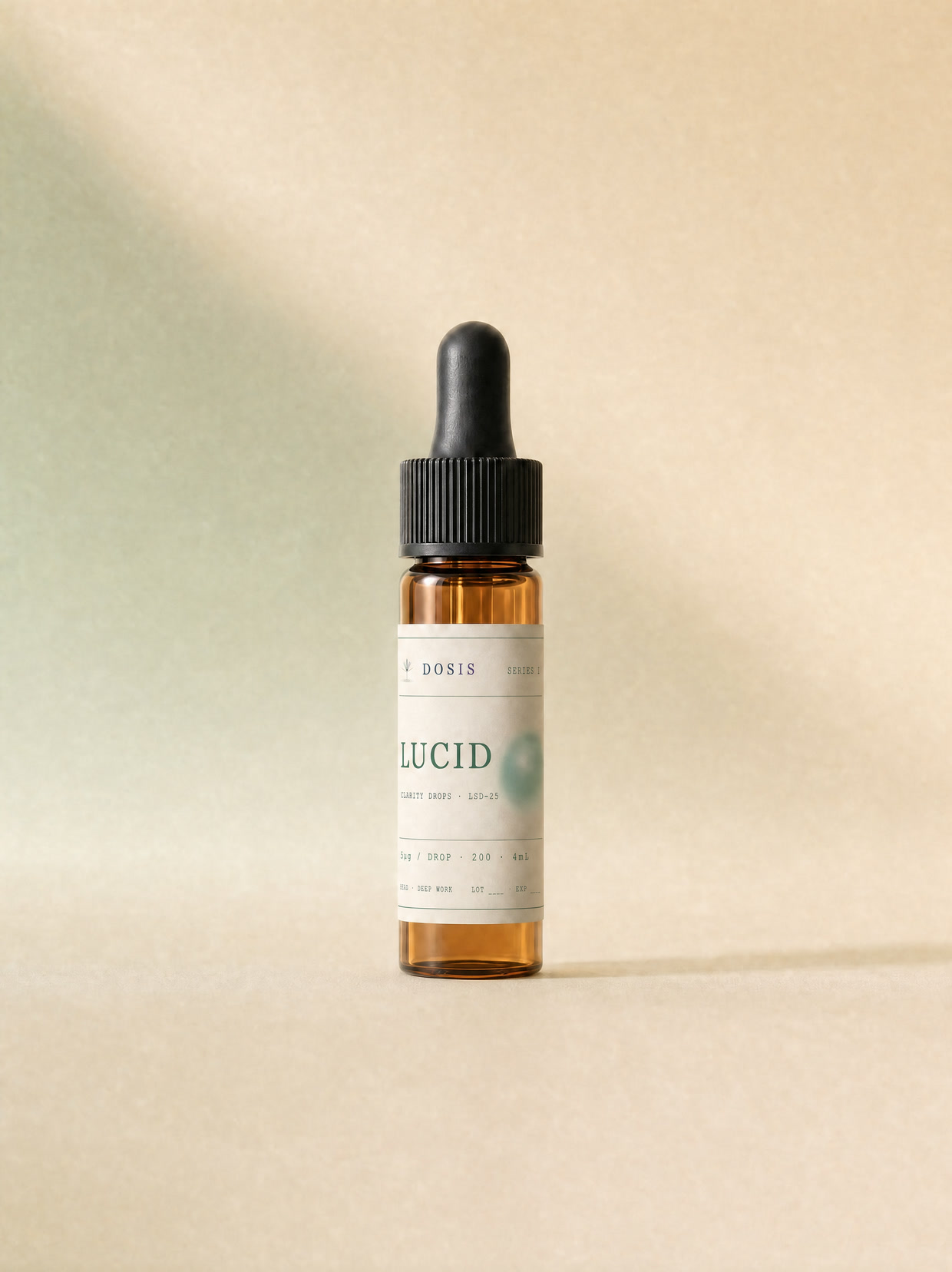
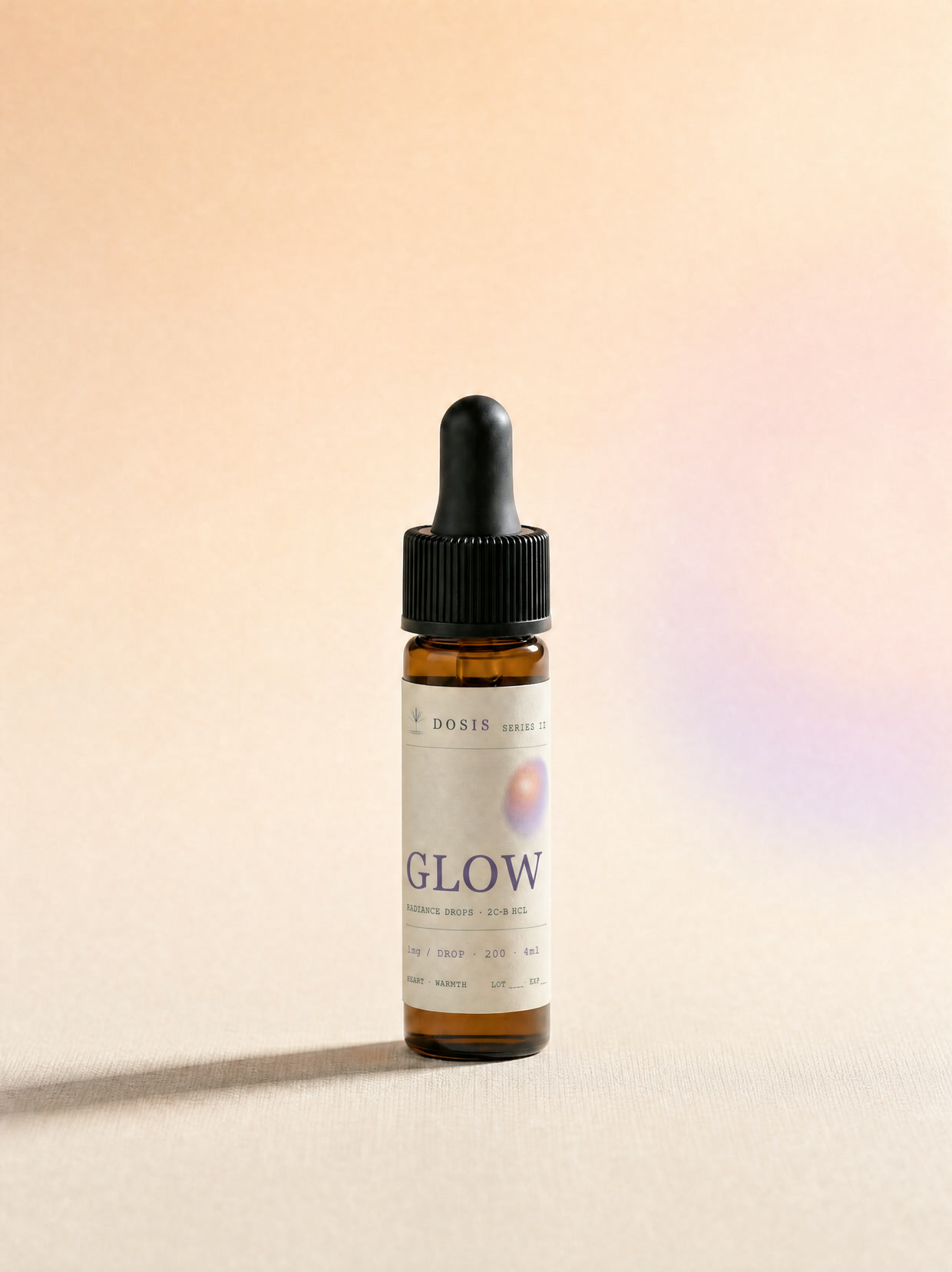
LUCID and GLOW can both support an intentional day, but they are not interchangeable. LUCID is the longer, head-centred option for continuity and deep work. GLOW is the shorter, warmer option for creative flow, sensory presence, and connection.
Duration is a planning range, not a promise. Dose, sensitivity, food, medication, sleep, and setting can all change onset, intensity, and length.
Choose LUCID for continuity.
When the workday is long, the task is analytical, and you want one measured start rather than repeated stimulation.
Choose GLOW for containment.
When the useful window is four to six hours and you want creative warmth without committing the entire day.
Similar format.
Different assignment.
Both arrive as measured liquid drops, and both are discussed in the language of flow. That is where the similarity ends. Their molecules, units, dose-response, felt character, and time commitment are different. The useful question is not “which is stronger?” It is “which profile belongs in this day?”
Allow a full-day runway.
A more contained commitment.
Analytical, pattern-forward, sustained.
Sensory, associative, relational.
Micrograms.
Milligrams.
The whole arc is not
one flat peak.
Think in phases: onset, a useful centre, and a taper. LUCID’s practical advantage is continuity. One early, measured start can span a long day, while the most useful work period may occupy the middle four to six hours. GLOW compresses the commitment: it can open a focused creative or social window, then return closer to baseline sooner.
Illustrative planning model—not a pharmacokinetic prediction. A shorter or longer response is possible with either compound.
The uninterrupted workday.
You have a hard research, writing, coding, or strategy problem and do not want to repeatedly top up caffeine. The priority is continuity, not a sudden rush.
The contained creative session.
You need ideation, sensory attention, conversation, or movement—but you do not want the choice to occupy the whole day.
The day that needs less.
If you are underslept, anxious, taking an interacting medication, driving, or unsure how you respond, neither product is the smart answer. A microdose is not emergency energy.
One leans into the task.
One opens the field.
Both can be described as “flow,” but the route is different. LUCID is chosen for a quieter, sustained analytical line. GLOW is chosen for warmth, association, and sensory or relational texture. These are product profiles and common reports—not guaranteed outcomes.
LUCID keeps
the thread.
Its value is not “more energy” in the caffeine sense. It is the possibility of staying with one difficult line of thought for longer, with fewer context switches and a broad runway around the work.
- Long-form writing, analysis, coding, and research
- Pattern recognition across complex information
- A single protected work block inside a full day
- Early starts with enough room for a long taper
GLOW changes
the texture.
Its appeal is containment and character: a shorter window with more emphasis on sensory presence, emotional openness, and associative creativity than on all-day analytical stamina.
- Ideation, art direction, music, and open-ended making
- Conversation, connection, and collaborative sessions
- Movement, nature, and sensory attention
- Days when twelve hours would simply be too much runway
Start with the day.
Then choose the drop.
The cleanest decision rule is logistical. What must be done? How long is the useful window? When do you need to be fully at baseline? If the schedule cannot safely hold the possible arc, the molecule does not belong in it.
You need one long line of attention.
The day begins early, the work is cognitively demanding, and an extended tail will not collide with sleep, driving, or another obligation.
You need a bounded shift in perspective.
The assignment is creative, sensory, or relational, and you want a shorter commitment that fits inside a defined part of the day.
You are trying to rescue a depleted day.
Neither formulation replaces food, sleep, breaks, or a safe baseline. Do not use either as a last-minute stimulant, and do not stack or redose to force the timeline.
A drop is a delivery unit.
Not a universal dose.
LUCID and GLOW use the same physical ritual—a calibrated liquid drop—but the contents cannot be compared by mass or drop count. One uses micrograms of LSD-25; the other uses milligrams of 2C-B HCl. Different molecule, different potency, different curve.
Do not convert them drop for drop.
A milligram is 1,000 micrograms, but that arithmetic says nothing useful about equivalence between two different psychoactive compounds. Potency is molecule-specific. Two drops of one product are not “the same” as two drops of the other.
Precision is especially important with GLOW because 2C-B has a steep dose-response at higher ranges. Taking more to make a short arc last longer is the wrong strategy: it can change intensity without predictably extending the useful window.
Use the dedicated per-product guide, keep one variable at a time, and never borrow a dose from the other formulation.
Useful ranges.
Honest limits.
The familiar 8–12-hour LSD and 4–6-hour 2C-B ranges are better supported at conventional doses than at microdose levels. Low-dose LSD has controlled human data, but the observed duration changes with dose. Controlled 2C-B microdose-duration data is essentially absent. Use the ranges to leave enough room in the day—not to predict an exact clock time or guaranteed workflow result.
A long arc is well documented.
In a placebo-controlled study of 100 µg oral LSD, subjective effects averaged 8.5 hours, with individual responses ranging from 5.3 to 12.8 hours. That supports a generous planning window, but it does not establish the same duration for every low dose.
HOLZE ET AL., 2019 · PUBMED ↗Microdose effects can be shorter.
In a controlled 5, 10, and 20 µg study, the 10 µg condition produced measurable subjective effects that ended at an average of 5.1 hours. Low-dose cognition findings remain mixed; “all-day focus” is not a proven outcome.
HOLZE ET AL., 2021 · PUBMED ↗The shorter arc is clearer at full doses.
A controlled 20 mg study found 2C-B effects largely resolved within six hours. That supports the shorter-window distinction, but it is not a validation of a 2–4 mg microdose profile or of any guaranteed creative benefit.
MALLARONI ET AL., 2023 · PUBMED ↗Before you choose.
Is GLOW just a shorter or weaker LUCID?
No. It is a different compound with a different dose unit, dose-response, and character. The shorter window is a feature when the day calls for containment; it does not make GLOW “half a LUCID.”
Does LUCID guarantee eight to twelve hours of focus?
No. Eight to twelve hours is a conservative planning arc, not a guarantee of continuous focus. Low-dose LSD studies have reported shorter measurable windows, and controlled evidence for productivity benefits is mixed. Plan the day generously and treat any useful focus as a response to observe, not a promised effect.
Can I take more GLOW to make it last like LUCID?
Do not use more dose to force a longer timeline. With 2C-B, additional dose can change intensity substantially without predictably creating the calm, extended work arc you wanted. Choose LUCID when duration is the requirement; never redose to “catch up.”
Is LUCID a caffeine replacement with no crash or jitters?
It should not be presented that way. Some people describe steadier continuity than repeated caffeine, while others experience activation, anxiety, distraction, or sleep disruption. Neither “no crash” nor “no jitters” can be guaranteed.
Can I use LUCID and GLOW together?
This guide does not recommend combining them. Stacking makes response, duration, and risk harder to read. Keep the formulations separate, change one variable at a time, and involve a qualified clinician if medication or health history creates any uncertainty.
What is the simplest decision rule?
Choose LUCID when you have an early start, an analytical assignment, and a full-day runway. Choose GLOW when you have a defined four-to-six-hour creative or connective window. Choose neither when you are depleted, anxious, driving, starting late, or cannot safely allow the possible duration.
Choose the profile.
Keep the intention clear.
Read the product overview first, then the molecule-specific science and safety guide. The comparison helps with fit; the dedicated pages carry the details.
LUCID
Head · clarity · deep work
Longer 8–12-hour planning arc.
GLOW
Heart · warmth · creative flow
Shorter 4–6-hour planning arc.
For educational and harm-reduction purposes only. Not medical advice. Microdosing evidence is preliminary and partly contested. LSD and 2C-B are controlled substances in many jurisdictions; know and follow the laws where you live. Avoid use with lithium, during pregnancy or breastfeeding, or with a personal or family history of psychosis or bipolar disorder. Do not drive or operate machinery if you feel any effect. Consult a qualified healthcare provider before beginning any protocol or if you take medication.